When your project depends on lifting, pulling, or positioning heavy loads, selecting the right hoist services is not just a logistical decision; it’s a critical factor in safety, efficiency, and overall project success. Whether you’re operating in construction, manufacturing, marine, mining, or infrastructure development, the performance of your hoisting equipment directly affects timelines, costs, and compliance.
Working with a reputable hoist company ensures that you receive not only reliable equipment but also expert guidance tailored to your specific project requirements. From choosing the correct pulley hoist to evaluating winch products for specialised applications, understanding the selection process will help you make informed decisions that protect your workforce and investment.
This guide outlines the essential factors to consider when selecting hoist services and explains how to match equipment and service capabilities to your project’s unique demands.
Understanding Your Project Requirements
Before contacting a hoist company, clearly define your project’s lifting needs. The more precise your requirements, the easier it will be to select suitable hoist services.
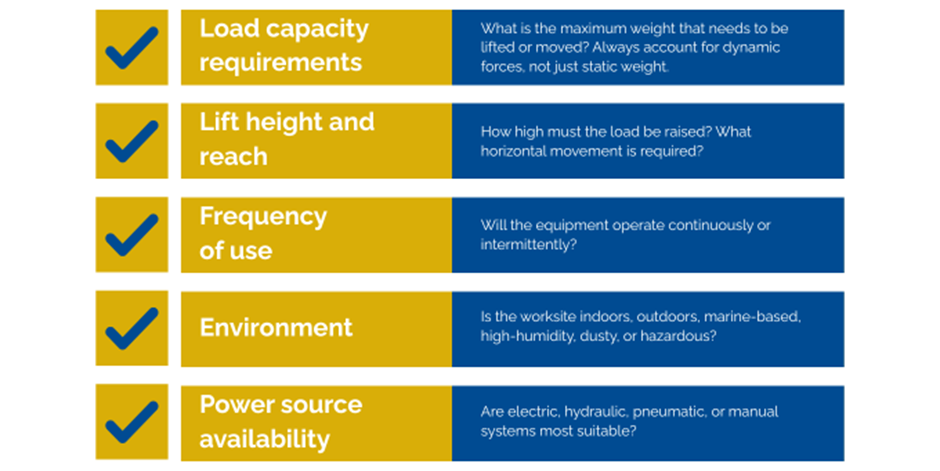
Start by evaluating:
- Load capacity requirements – What is the maximum weight that needs to be lifted or moved? Always account for dynamic forces, not just static weight.
- Lift height and reach – How high must the load be raised? What horizontal movement is required?
- Frequency of use – Will the equipment operate continuously or intermittently?
- Environment – Is the worksite indoors, outdoors, marine-based, high-humidity, dusty, or hazardous?
- Power source availability – Are electric, hydraulic, pneumatic, or manual systems most suitable?
Different projects require different hoisting equipment configurations. For example, a compact pulley hoist may be ideal for controlled vertical lifting in tight industrial settings, while heavy-duty winch products may be better suited for pulling and tensioning applications in marine or construction environments.
Clearly identifying these factors allows hoist services providers to recommend the most appropriate equipment and service level.
Evaluating Load Capacity and Safety Margins
Load capacity is one of the most critical considerations when selecting hoist services. Choosing equipment that operates too close to its maximum rated capacity can increase wear, reduce lifespan, and create safety risks.
A reputable hoist company will help you to determine things such as the correct Working Load Limit (WLL), help you to include appropriate safety margins, and account for rigging weight and attachments. For example, when selecting a pulley hoist, the load rating must comfortably exceed the heaviest anticipated load. Similarly, when evaluating winch products, pulling capacity must consider line layers, drum diameter, and angle of pull.
Professional hoist services providers conduct detailed assessments to ensure the equipment not only meets but exceeds safety expectations. This proactive approach reduces downtime, liability, and long-term maintenance costs.
Assessing Service History and Industry Experience
Not all hoist services providers offer the same level of expertise. Experience matters, especially in industries where safety and precision are non-negotiable.
When evaluating a hoist company, it would be worth considering client testimonials and reviews, how many years of operation they have in the industry, and any certifications and technical qualifications.
An experienced provider understands the nuances of different applications. For instance, marine hoisting equipment must resist corrosion and salt exposure, while mining applications require robust, heavy-duty systems built for harsh environments.
A company with a proven service history can anticipate potential challenges and recommend reliable solutions tailored to your project’s operating conditions.
Ensuring Compliance with Safety Regulations
Compliance with local, national, and international safety standards is essential when selecting hoist services. Regulatory requirements vary by industry and region, and failure to comply can result in fines, project delays, or serious accidents.
Professional hoist services providers should:
- Supply equipment certified to recognised standards
- Conduct routine inspections and testing
- Maintain detailed service records
- Provide operator training where required
- Offer documentation for audits and compliance reviews
Whether you are installing a pulley hoist in a manufacturing facility or deploying winch products on a construction site, compliance must remain a top priority. A reputable hoist company will stay up to date with evolving regulations and ensure that your equipment meets all applicable standards.
Matching Equipment Types to Project Applications
Different types of hoisting equipment serve distinct purposes. Selecting the right solution involves understanding the strengths and limitations of each option.
Pulley Hoists
A pulley hoist is commonly used for vertical lifting in controlled environments. These systems are ideal for workshops and warehouses, assembly lines, equipment installation, and maintenance tasks. They offer simplicity, reliability, and precise load control. For projects requiring repeated vertical lifts with moderate loads, a pulley hoist can provide cost-effective and efficient performance.
Electric and Hydraulic Hoists
For higher-capacity or continuous-use applications, electric or hydraulic hoists may be more suitable. These systems are commonly used in construction sites, industrial manufacturing, heavy fabrication and infrastructure projects. They deliver increased lifting power, consistent operation, and enhanced safety features.
Winch Products
Winch products are typically used for pulling, tensioning, and positioning loads rather than purely vertical lifting. They are widely utilised in marine and offshore operations, vehicle recovery and towing, material handling on inclines and utility and infrastructure projects.
Selecting the correct winch products involves evaluating line speed, drum capacity, mounting configuration, and power source compatibility.
By clearly understanding your project’s operational demands, a qualified hoist company can recommend the most appropriate equipment combination.
Considering Customisation and Engineering Support
Standard equipment may not always meet specialised project requirements. In complex environments, customised hoisting equipment or engineered solutions may be necessary.
Look for hoist services providers that offer custom fabrication and modifications, engineered lifting solutions, integration with existing systems and on-site assessments and technical consultations.
Engineering support ensures that your hoisting equipment integrates seamlessly with your workflow. Whether modifying a pulley hoist for confined spaces or configuring winch products for offshore conditions, tailored solutions enhance safety and performance.
Evaluating Maintenance and Ongoing Support
Hoisting equipment requires regular inspection and maintenance to remain safe and operational. Selecting hoist services should involve more than just purchasing or renting equipment—it should include a long-term support strategy.
Key maintenance considerations include:
- Preventative maintenance programs
- Emergency repair services
- Spare parts availability
- Inspection scheduling
- Load testing services
A dependable hoist company will provide ongoing service agreements to ensure your equipment operates at peak performance. Proactive maintenance reduces unexpected breakdowns, extends equipment lifespan, and ensures continued compliance.
Balancing Cost with Long-Term Value
While cost is always a factor, choosing hoist services based solely on price can lead to higher expenses over time. Low-quality hoisting equipment or inadequate service support may result in downtime, repairs, and safety risks.
Instead, evaluate value based on terms such as equipment reliability and durability, service quality and responsiveness, technical expertise and consultation and then the total cost of ownership.
Partnering with an experienced hoist company ensures that you receive dependable equipment and professional guidance that protects your investment.
The Importance of Communication and Partnership
Successful projects depend on collaboration. The right hoist services provider should function as a partner, not just a supplier.
Effective communication includes:
- Clear project scope discussions
- Transparent pricing and timelines
- Detailed technical explanations
- Responsive customer support
- Ongoing performance evaluations
When a hoist company takes the time to understand your project goals, they can proactively identify risks, suggest improvements, and provide solutions that align with your operational objectives.
Making the Right Choice
Choosing the right hoist services for your project requires careful evaluation of load requirements, environmental conditions, compliance standards, and long-term support needs. From selecting the appropriate pulley hoist to evaluating specialised winch products, every decision impacts safety, efficiency, and project outcomes.
By partnering with a reputable hoist company that offers proven experience, certified hoisting equipment, and comprehensive maintenance services, you ensure that your lifting operations remain reliable and compliant.
Ultimately, the right hoist services provider does more than supply equipment—they deliver expertise, safety assurance, and customised solutions that help your project succeed from start to finish.