
Selecting the right winch for your project is not simply about choosing the most powerful unit available. Each application comes with its own technical demands, safety considerations and environmental factors. Making the correct choice will directly influence performance, compliance and overall project efficiency.
With over 30 years of experience supplying lifting and pulling equipment across Scotland, Essex and the wider UK, we understand that no two projects are the same. Whether supporting marine load outs, bridge launching, cable pulling or offshore installations, we focus on providing solutions tailored to specific operational needs.
Start by Defining the Purpose of the Project
Before selecting any winch, it is essential to clearly define what the equipment will be required to do. The intended function will guide every other decision.
Lifting vs Pulling Applications
Some projects require vertical lifting, while others involve horizontal pulling or controlled positioning. A hoist and winch system designed for lifting structural components will differ significantly from one used for cable installation.
For example, marine and offshore environments may require heavy-duty pulling capacity for vessel movement or rig positioning. In contrast, bridge launching projects demand carefully controlled movement under substantial load.
Industry-Specific Demands
Each sector has unique operational requirements. Utility projects often involve long-distance cable pulling with high resistance, while oil and gas installations must operate within strict safety frameworks. Engineering and construction projects frequently demand precise positioning combined with high load capacity.
Understanding the industry context ensures that the selected winch meets both performance and regulatory expectations.
Calculating Load Capacity Accurately
One of the most critical factors when choosing a winch is determining the correct load capacity. This should never be estimated or assumed.
Assessing Maximum Load Weight
You must calculate the full weight of the load, including any additional forces that may increase resistance. This can include friction, gradients, environmental resistance or dynamic forces during movement.
Selecting a large winch may be necessary for heavy infrastructure projects such as bridge launching or offshore operations. However, overspecifying equipment can lead to unnecessary costs, while underspecifying creates serious safety risks.
Factoring in Safety Margins
A suitable safety margin should always be built into your calculations. This ensures that the winch operates comfortably within its limits rather than at maximum capacity throughout the project.
Careful assessment of line pull requirements is particularly important for cable pulling applications within the utilities sector, where tension control must remain consistent and safe.
Choosing the Right Power Source
The working environment will heavily influence which power source is most suitable for your winch. At Atlas Winch Hire & Hoist Services, we offer a wide range of winches and hoists for you to choose from, making finding the right solution for your needs simple.
Electric Power Solutions
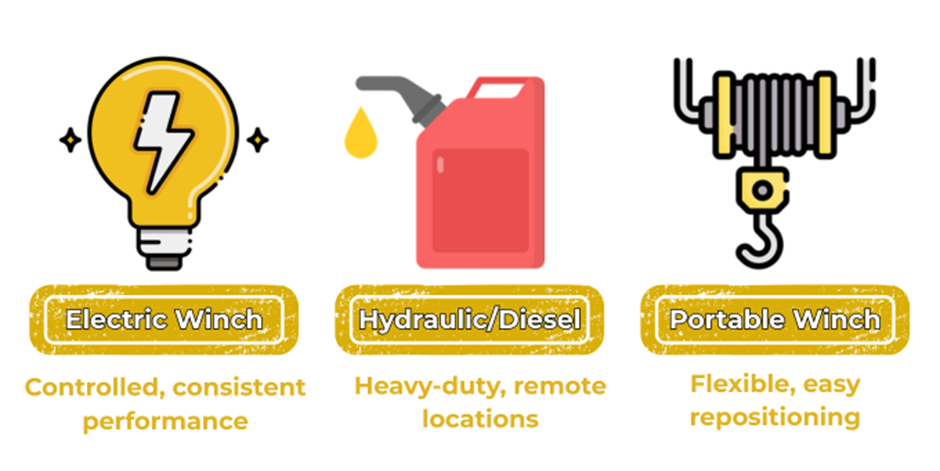
An electric winch is often chosen for projects requiring precise control and consistent performance. Where a stable power supply is available, electric systems offer reliable operation and efficient load management.
Electric options are particularly effective for construction, engineering and controlled lifting operations where smooth, incremental adjustments are required.
Hydraulic and Diesel Options
In remote or demanding environments, hydraulic or diesel-powered systems may be more appropriate. Offshore and marine projects frequently rely on specialised power packs to ensure dependable operation in harsh conditions.
Choosing the right power configuration ensures that performance is not compromised by site limitations.
Flexible and Portable Equipment
Where mobility is essential, a portable winch can offer practical advantages. These systems are well-suited to confined spaces or projects requiring frequent repositioning of equipment.
However, portability should not come at the expense of capacity. The decision must balance flexibility with sufficient power to complete the task safely.
Considering Control and Precision
Not every application requires the same level of control, so understanding the degree of precision needed is essential.
Controlled Movement for Structural Projects
Bridge launching and heavy engineering operations require gradual, carefully monitored movement. In these cases, the hoist and winch system must allow fine adjustments to maintain structural alignment and safety.
An electric winch often provides enhanced control features that support these precision requirements.
Tension Monitoring in Cable Pulling
Cable installation projects demand careful tension regulation to prevent damage. Integrating load monitoring equipment ensures that safe limits are maintained throughout the operation.
Precision control is not simply about performance; it is fundamental to safety and compliance.
Assessing Installation and Space Constraints
The physical layout of your site can influence which winch is most suitable. Here are some key considerations to think about.
Fixed and Base-Mounted Systems
For large-scale operations, a securely mounted large winch may offer the stability required. These systems are ideal for heavy infrastructure projects where the equipment remains in a fixed position. Secure anchoring and integration with other lifting systems must be considered during planning.
Compact and Temporary Installations
Where space is limited or access is restricted, smaller or portable solutions may be more appropriate. Temporary installations often benefit from flexible equipment that can be quickly deployed and repositioned. Careful site assessment ensures that installation constraints do not hinder performance.
Prioritising Safety and Compliance
Safety is central to every lifting and pulling operation. Compliance with industry standards must never be overlooked.
Meeting Industry Regulations
Sectors such as oil and gas, utilities and marine operate under strict regulatory frameworks. The selected winch must meet relevant certification and inspection requirements. Ensuring that equipment is tested and compliant protects both personnel and project timelines.
Ongoing Servicing and Testing
Regular inspection and maintenance are critical for maintaining performance and compliance. Selecting equipment backed by professional servicing support reduces the risk of downtime. Reliable technical support ensures that your project continues without disruption.
Considering Duration and Frequency of Use
Project timescales and operational intensity should influence your decision. Below, discover two key things to consider.
Short-Term vs Long-Term Projects
Short-term projects may benefit from hire solutions, providing access to high-quality equipment without long-term capital investment. Hiring also offers flexibility to scale equipment according to project needs. Long-term or continuous heavy-duty operations may justify selecting more robust systems capable of sustained performance.
Matching Equipment to Workload
A large winch designed for constant industrial use may be unnecessary for occasional tasks. Conversely, underestimating workload demands can compromise safety. Balancing performance with realistic usage expectations ensures cost-effective decision-making.
Balancing Performance with Budget
Budget considerations naturally form part of any equipment decision. However, cost should never override safety or operational reliability.
Carefully matching your winch to project requirements avoids unnecessary expenditure while maintaining performance standards. Hiring specialist equipment can provide an efficient solution where purchasing is not practical. A considered approach ensures you receive maximum value without compromising quality.
The Value of Expert Guidance
Even with careful planning, selecting the right winch can be complex. Every project presents unique technical challenges.
With decades of experience across marine, construction, utilities, oil and gas, engineering and renewables, we provide tailored advice based on detailed project assessment. From semi-submersible rig load-outs to high-capacity cable pulling operations, our focus is always on delivering safe, reliable solutions.
Attention to detail is central to our approach. Tight deadlines leave no room for error, so we ensure every specification aligns precisely with your operational needs.
Making the Right Decision with Confidence
Choosing the right winch involves more than selecting a product; it requires understanding your load requirements, environment, power availability, control needs and compliance obligations.
Whether you require an electric winch for precise control, a portable winch for flexibility or a large winch for heavy infrastructure work, careful assessment ensures optimal performance and safety.
If you are planning a project and need specialist advice, we are here to help. With depots in Scotland and Essex and nationwide coverage, we supply reliable hoist and winch solutions tailored to your exact requirements.
Contact us today to discuss your project and let us help you select the right equipment with confidence, efficiency and industry expertise.