
Every safe and successful lift depends on far more than the winch itself. The accessories fitted around it, from lifting slings to load monitoring systems, are what turn a powerful machine into a controlled, compliant lifting operation. Choosing the right winch accessories isn’t just about convenience; it directly affects the safety of your team, the integrity of your load and how efficiently a job gets done.
In this guide, we answer the questions we’re asked most often about winch accessories, covering the essentials every site should have on hand, and how they support safe, compliant lifting across construction, utilities, marine, oil and gas, and renewables projects.
What accessories do you need for safe winch lifting operations?
At a minimum, a safe winching setup should include a suitably rated lifting sling or attachment method, a reliable winch cable in good condition, some form of load monitoring, and a control system that lets the operator manage the lift with precision. Depending on the application, extension straps, snatch blocks and shackles may also be required to extend reach or redirect the pulling line.
The right combination depends on the load weight, the working environment and the industry regulations that apply to your site. Utility cable pulling, for example, calls for very different accessories than a marine mooring operation or a construction lift.
In short, a safe winch setup is built from several accessories working together, not the winch alone.
Why do lifting slings matter for safe winch operations?
Lifting slings are the primary connection between your winch line and the load, so their condition and specification matter enormously. A sling that’s undersized, damaged or unsuitable for the material being lifted can fail under tension, putting both personnel and equipment at serious risk.
Slings come in several forms, including wire rope, webbing and round slings, chain slings, each suited to different loads and environments. Wire rope slings offer excellent durability for heavy, abrasive loads, while webbing and round slings provide a softer option that protects more delicate surfaces from damage. Selecting the correct configuration, whether single, double or multi-leg, also plays a part in keeping the load balanced and controlled throughout the lift.
We supply a full range of lifting slings and rigging equipment, including bespoke wire rope slings manufactured to your exact specification, so you’re never left trying to make an unsuitable sling work for the job at hand.
In short: the right lifting sling protects the load and the people around it, so it should always match the weight, shape and material being lifted.
What role do winch extension straps play in safe lifting?
Winch extension straps allow you to increase the working distance between the winch and the anchor point or load, which is particularly useful when the anchor point is further away than the standard cable length allows, or when you need to keep the winch itself at a safe distance from a hazardous area.
Beyond simply extending reach, a good extension strap reduces strain on the winch cable itself by taking on some of the tension load, helping to prevent premature wear. As with any load-bearing accessory, extension straps must be rated for the job and inspected regularly for fraying, abrasion or UV damage, particularly if they’re used outdoors or in marine environments.
In short: extension straps give you more flexibility over anchor points and working distance, without compromising on safety, provided they’re correctly rated and well maintained.
How does load monitoring equipment improve safety and compliance?
Load monitoring equipment measures the tension being applied to a winch line in real time, allowing operators to see exactly how close a lift is running to the equipment’s safe working load. This is one of the most important accessories on any site, since overloading is a leading cause of lifting incidents.
Modern load monitoring systems, such as load links and running line monitors, provide wireless data to a handheld display or base station, so the operator always has an accurate picture of the forces involved. Some systems also offer data logging, giving you a downloadable record of every lift, which is invaluable for demonstrating compliance during audits or inspections.
Under the Lifting Operations and Lifting Equipment Regulations 1998 (LOLER), employers have a legal duty to ensure lifting equipment is used within its safe working limits, and load monitoring is one of the most practical ways to meet that duty in practice. We supply load monitoring systems covering capacities from 6.5 tonnes up to 500 tonnes, including ATEX-rated options for hazardous environments.
In short: load monitoring gives operators real-time visibility of tension, helping prevent overloads and supporting LOLER compliance.
Why is choosing the right winch cable so important?
The winch cable is the single point of contact between the machine and the load, so its condition, material and specification have a direct bearing on safety. Steel wire cables offer high tensile strength and durability for heavy-duty pulls, while synthetic ropes are lighter, easier to handle and less prone to the kinking that can weaken steel cables over time.
Cable diameter and construction need to be matched to the winch’s drum capacity and the loads being handled; an undersized or worn cable is a common cause of slippage, snapping or reduced pulling performance. Regular inspection for fraying, kinks and corrosion should be part of every pre-use check, with any damaged sections replaced before the winch goes back into service.
In short: a well-specified, well-maintained winch cable is fundamental to safe and efficient pulling, and it should always be matched to the winch and the load.
What difference do control systems make to winching operations?
Control systems, from wired and wireless remote controls to variable speed and emergency stop functions, give operators far greater command over a lift. Being able to control the winch from a safe distance is particularly valuable in hazardous environments, confined spaces, or where the operator needs a clear line of sight to the load without standing directly in the line of pull.
Variable speed control also allows for smoother, more precise movements, which matters when positioning delicate equipment or manoeuvring a load into a tight space. Emergency stop functions add another layer of protection, allowing an operation to be halted instantly if conditions change unexpectedly.
Our electric winches are available with a range of control features to suit different applications, giving you the precision and safety control your project needs, whether you’re working indoors, offshore or on a busy construction site.
In short, the right control system gives operators precision and a safe distance from the load, both of which reduce risk on site.
Which winch accessories suit which applications?
Not every project needs the same combination of accessories. The table below offers a quick comparison to help you identify what’s likely to matter most for your job.
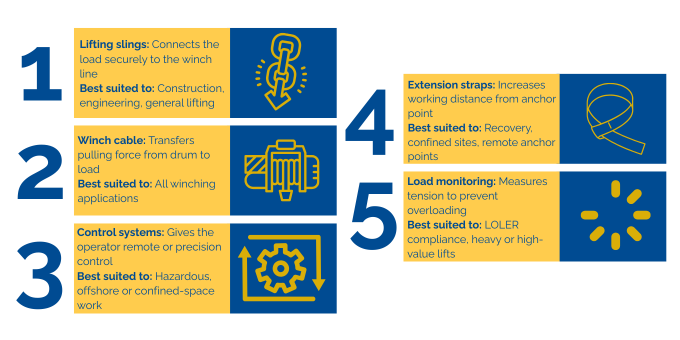
In short, matching accessories to the application, rather than defaulting to a standard setup, is what keeps a lift both safe and efficient.
How do you choose the right winch accessories for your project?
Start by identifying the load weight, the working environment and any regulatory requirements that apply, such as LOLER or PUWER. From there, consider whether you need extended reach, real-time load data, or remote operation, and choose accessories that are rated for the specific conditions on site, whether that’s a marine environment, an explosive atmosphere or a busy construction yard.
It’s also worth thinking beyond the immediate job. Accessories that can be hired alongside a winch, rather than bought outright, give you the flexibility to scale up or down as project requirements change, without tying up capital in equipment you may only need occasionally.
Our team has decades of experience matching winch accessories to specific project requirements, across marine, oil and gas, construction, engineering, utilities and renewables. If you’re not sure which combination is right for your job, we’re always happy to talk it through.
Ready to equip your next lift?
Whatever your project involves, from cable pulling to marine load-outs, having the right accessories in place makes all the difference to safety, compliance and performance. Get in touch with our team today to discuss your winch accessory requirements, and we’ll help you put together a setup that’s tailored to your job and your budget.
Contact us to speak to a winch specialist, or explore our full range of rigging equipment and load monitoring systems online.